



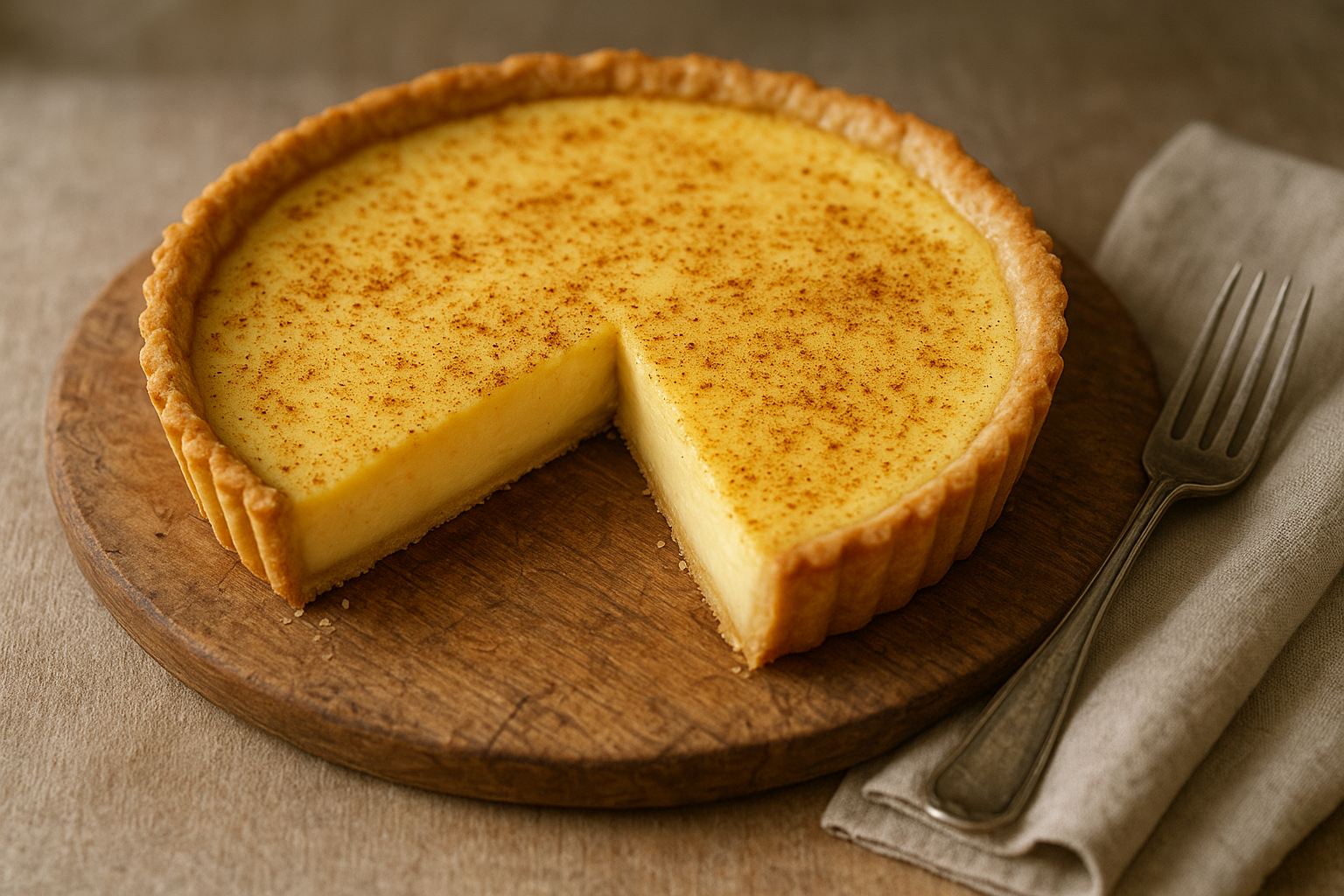
Classic British Custard Tart
A timeless British custard tart: a crisp sweet shortcrust shell filled with smooth, nutmeg-dusted baked custard. This custard tart recipe focuses on simple ingredients and technique for a silky filling and a perfectly baked shell.

Ingredients
- For the sweet shortcrust pastry:
- 250 g plain flour (about 2 cups)
- 140 g cold unsalted butter, cubed
- 50 g caster (superfine) sugar
- 1 large egg, beaten
- Pinch of salt
- For the custard filling:
- 400 ml whole milk (or 300 ml milk + 100 ml double cream for extra richness)
- 3 large eggs + 1 egg yolk (room temperature)
- 75–90 g caster sugar (adjust to taste)
- 1 tsp vanilla extract or seeds from 1 vanilla pod
- Freshly grated nutmeg, to dust
- Optional: finely grated zest of 1 lemon and 1 tbsp melted butter for extra silkiness
Equipment
- 9–10 inch (23–25 cm) tart tin with removable base
- Rolling pin
- Baking beans or ceramic weights for blind-baking
- Fine sieve
- Mixing bowls, whisk and a jug
Instructions
- Make the sweet shortcrust: Rub the cold butter into the flour and salt until the mixture resembles coarse breadcrumbs. Stir in the sugar. Add the beaten egg and bring together quickly to form a dough — don’t overwork it. Flatten into a disc, wrap and chill for at least 30 minutes.
- Line and blind-bake: Roll the chilled pastry on a lightly floured surface to fit your tart tin. Ease into the tin, trim the edges, then dock the base with a fork. Line with baking paper and fill with baking beans. Blind-bake at 180°C/350°F for 15–20 minutes until the pastry is pale golden and the base looks dry. Remove beans and paper and return to the oven for 3–5 minutes to dry the base further if needed. Reduce oven to 160–170°C/320–340°F for later baking.
- Make the custard: In a bowl, whisk together the eggs, egg yolk and sugar until pale. Gently heat the milk (and cream if using) until just below simmering; remove from the heat and stir in vanilla and optional lemon zest and butter. Gradually pour the warm milk into the egg mixture in a thin stream, whisking constantly. Strain the mixture through a fine sieve into a jug to remove any cooked bits and ensure smoothness.
- Fill and bake: Place the blind-baked shell on a baking tray and pour the strained custard into the shell. Bake at 160–170°C/320–340°F for 25–35 minutes until the edges are set and the centre is just slightly wobbly — it will continue to set as it cools. Avoid overbaking to prevent curdling or a grainy texture.
- Cool and rest: Remove the tart from the oven and allow it to cool to room temperature on a wire rack, then chill for at least 1 hour to finish setting for cleaner slices. Dust with freshly grated nutmeg just before serving.
Timing & temperature notes
Blind-bake: 15–20 minutes at 180°C/350°F. Fill and bake: 25–35 minutes at 160–170°C/320–340°F. Oven times vary with tin size, oven accuracy and if you use convection (reduce by ~10–20°C).
Nutrition estimate (per slice, serves 8)
Approx. 300–350 kcal • Fat 18g • Carbs 29g • Protein 6g (estimate only)
Pro tips: Use room-temperature eggs so the custard mixes smoothly; always strain the custard before pouring to remove any coagulated bits; dock and weigh down pastry for an even blind-bake; remove the tart when the centre is slightly wobbly to avoid overbaking and curdling.
Serving ideas
- Dust with freshly grated nutmeg or a light dusting of icing sugar.
- Serve warm or chilled with fresh berries, a spoonful of fruit compote or clotted cream.
- Pair with black tea for a classic British finish.
FAQ
How do I know when the custard is set?
Can I use single milk instead of cream?
Why did my custard crack or weep?
Can I use ready-made pastry or make substitutions?
More recipes and baking guides at MadeForRecipes: Recipes. For background on classic British bakes see BBC Good Food.