


Classic Battenberg Cake — Battenberg cake recipe
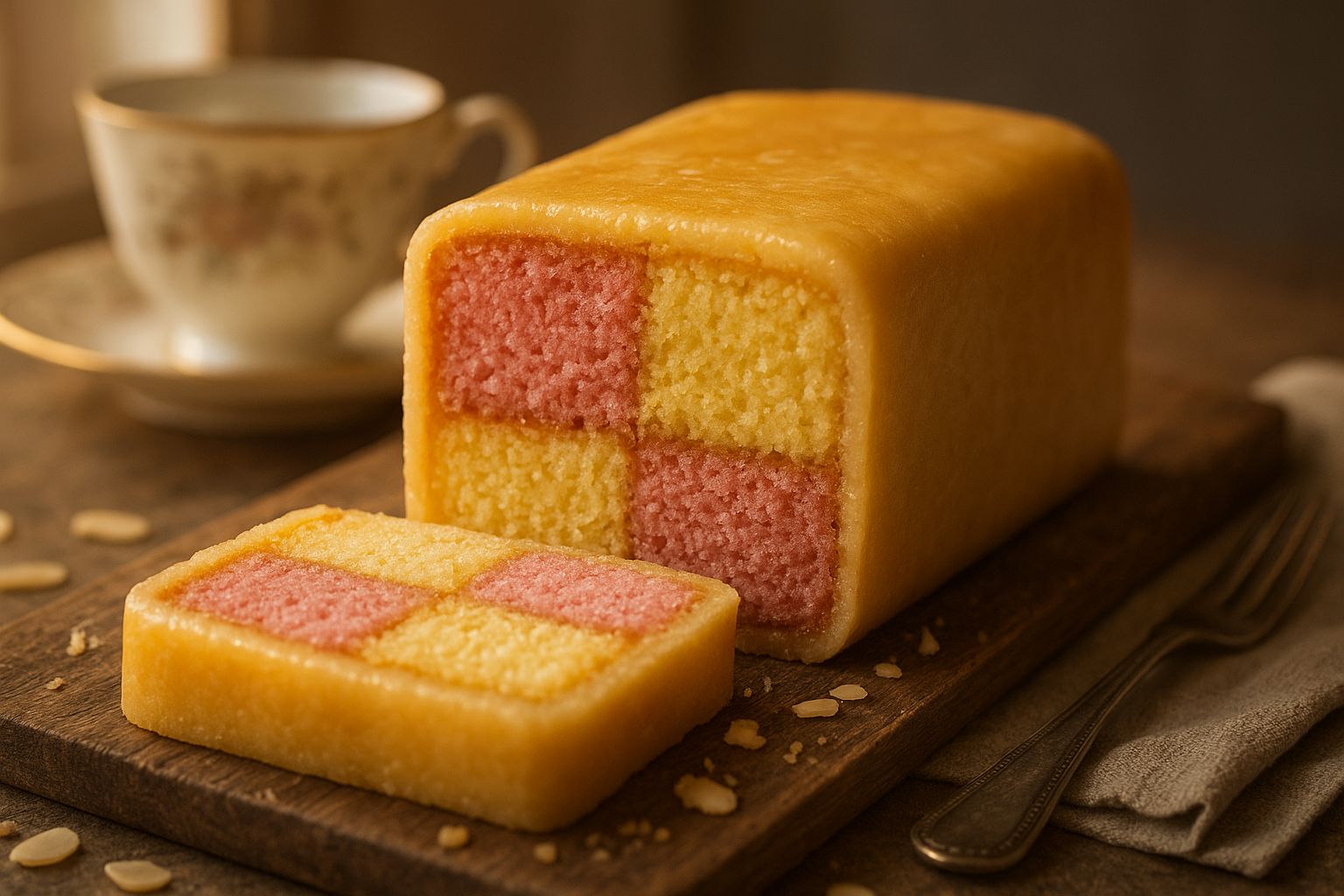
A Victorian favorite: a light almond sponge in pink and yellow checkerboard squares, sandwiched with apricot jam and wrapped in smooth marzipan. This Battenberg cake recipe yields a striking, sliceable cake perfect for tea.

Ingredients
- 225g unsalted butter, softened
- 225g caster sugar
- 4 large eggs, at room temperature
- 225g self-raising flour, sifted
- 1 tsp baking powder
- 1 tsp almond extract
- Pink food colouring, a few drops
- 6–8 tbsp apricot jam, sieved and warmed
- 500g ready-to-roll marzipan
- Optional: flaked almonds for decoration
Equipment
- Two 20 x 5 cm strip tins (or one 20 cm square tin)
- Electric mixer or wooden spoon
- Mixing bowls, spatula, sieve
- Baking parchment, sharp knife, rolling pin
- Small pastry brush (for jam)
Instructions
- Preheat the oven to 180°C / 160°C fan / 350°F. Grease and line your strip tins (or line a square tin).
- Cream the unsalted butter and caster sugar together until pale and fluffy.
- Beat in the eggs, one at a time, adding a tablespoon of flour if the mixture looks curdled. Stir in the almond extract.
- Fold in the sifted self-raising flour and baking powder until just combined.
- Divide the batter evenly into two bowls. Tint one portion pink with a few drops of food colouring, folding gently to keep the mixture light.
- Spoon the batters into the prepared tins (one colour per tin) or pour both into a square tin in two blocks and level the tops. Bake for 20–25 minutes or until a skewer comes out clean. Allow to cool slightly in the tin, then turn onto a wire rack to cool completely.
- If baked in a square tin, trim the loaf into even strips (two of each colour) using a sharp knife. If baked in strip tins, trim edges for neatness.
- Warm the apricot jam and sieve to remove lumps. Lightly brush a thin layer on the cut faces of the strips.
- Sandwich the strips together in an alternating pink/yellow/pink/yellow pattern using the warmed jam as glue to form the checkerboard block. Press gently so the seams meet neatly.
- Dust your work surface with icing sugar, roll out the ready-to-roll marzipan to a size large enough to wrap the cake. Brush the cake with a thin layer of warm jam and carefully wrap with marzipan, sealing the edges beneath the cake. Trim any excess and finish edges neatly. Optional: brush with extra jam and sprinkle flaked almonds on top.
- Rest the wrapped cake for at least 30 minutes before slicing to allow the jam to set and avoid cracking of the marzipan. Slice with a very sharp knife to show the checkerboard pattern.
Nutrition estimate (per slice)
Approx. 420 kcal • Fat 24g • Carbs 45g • Protein 6g
Pro tips: Weigh ingredients for accuracy, colour the batter evenly, trim gently for neat edges, warm jam to act as a glue, and rest the cake before wrapping to prevent marzipan cracking.
Serving ideas
- Slice to display the checkerboard and serve with tea or clotted cream.
- Pack slices for picnics or afternoon tea platters.
- For a show-stopping platter, pair with fresh berries and a dusting of icing sugar.
FAQ
Q: How do I cut even strips for the checkerboard?
A: Use a ruler and mark the cake with a toothpick to guide even cuts. If using a square tin, cool completely and use a sharp serrated knife for straight edges.
Q: Are there alternatives to marzipan?
A: You can use fondant icing as an alternative, though marzipan adds the classic almond flavour. For nut-free options, try a thin layer of fondant or rolled icing instead.
Q: How should I store or freeze Battenberg cake?
A: Store wrapped in an airtight container in a cool place for 3–4 days or refrigerate for up to a week. Freeze unwrapped in slices between layers of baking paper for up to 2 months; thaw in the fridge.
Q: Troubleshooting — why is my marzipan soggy or my sponge collapsed?
A: Soggy marzipan usually means too much jam or insufficient setting time — brush off excess jam and allow to rest before wrapping. A collapsed sponge can be overmixed or underbaked; check oven temp and fold batter gently to retain air.
Looking for more recipes? Browse our collection at MadeForRecipes – Recipes. For marzipan tips and traditional techniques, see BBC Good Food.